How to Process an Administrative Transfer
Step 1: Contact with Executor or Administrator
An Estate Executor or Administrator has contacted you requesting the transfer of estate lands in accordance with an approved Will The legal statement concerning the disposition of one's property after death; the document containing such wishes or the intestacy provisions of the Indian Act (Section The primary division of the Township, a land area measure that contains about 640 acres; in the Dominion Lands Township System, it is used in the Provinces of Manitoba, Saskatchewan, Alberta and British Columbia. 48)
If your First Nations has a staff dedicated to managing estates, it is imperative that you work together to identify any circumstances that may impact the successful Administrative Transfers associated with the estate in question.
Step 2: Take Notes
Use Sample Lands File Note to take detailed notes of the conversation or email noting the following:
-
Full name of executor/administrator
-
Do they have one of the following?
-
An “Appointment of Administrator”
-
An “Approval of Will”
-
An “Appointment of Estate Trustee” or
-
Any other documentation deemed to have appointed a representative of the Estate (i.e. – provincial documents)
-
-
-
Address of executor/administrator
-
Legal land description they wish to transfer
-
Name, DOB and band number of deceased locatee
-
Date they passed on
-
The full name and 10-digit band number of each individual the estate lands are to be distributed to
-
Indicate whether it be transferred as joint tenants or tenants-in-common. If you do not indicate, the default is tenants in common.
-
Note whether a minor is involved
-
Discuss MRP requirements (i.e. spousal consent, stat dec forms, know your rights MRP pamphlet)
Step 3: Land Research/Verification
-
Pull Parcel
An area of reserve land regardless of dimension. Abstract -
Ensure that the land is registered to the deceased
-
Review for any encumbrances
-
Verify access
-
Double check the Reserve
A tract of land, the legal title to which is vested in Her Majesty that has been set apart for the use and benefit of a Band/First Nation. General to check for any additional encumbrances, i.e. blanket permits, etc. -
eRip print out (not to be used as an official survey plan – for reference only)
-
GoogleEarth print out (not to be used as an official survey plan – for reference only)
-
Print Survey plan
Step 4: Prepare the Admin Land Transfer
-
Obtain form from ISC Regional Office: Request for Transfer
The process which allows a lawful possessory (locatee) to give his or her lawful possession of reserve land to another member of the First Nation, or Band, under section 24 of the Indian Act. of Land by Executor/Administrator INTRA 83-021E 2019-03-15 (A) The Request for Transfer of Land by Executor/Administrator form does not require an Affidavit of Execution
A written statement, sworn before a person having authority to administer an oath, by a person having witnessed a document testifying to the document having been signed by the parties thereof. . -
Before you have the Transfer of Land signed/executed, proofread all document for information such as correct names, First Nation numbers, and legal land Descriptions.
Step 5: Prepare the MRP Forms
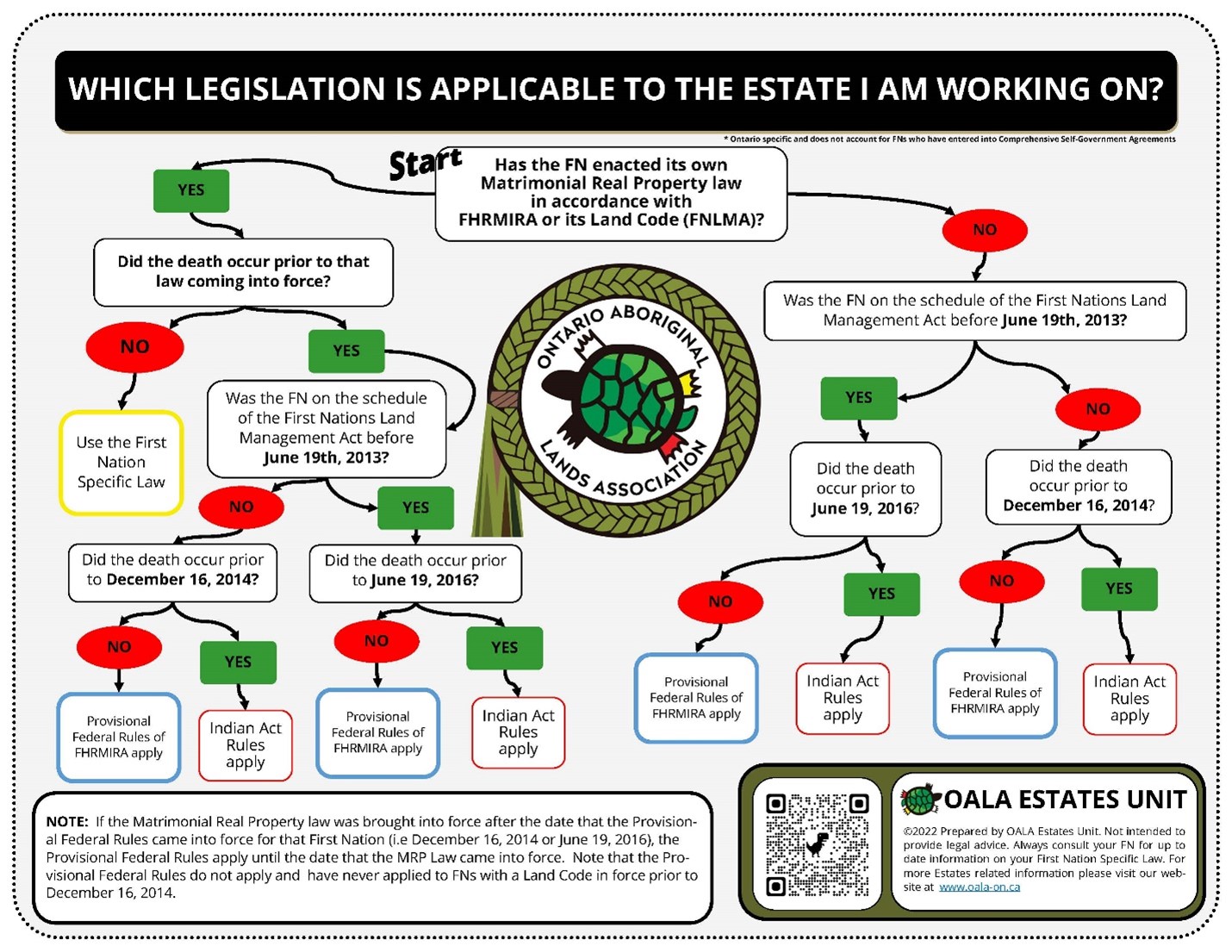
If your First Nation has developed and ratified its own law that deals specifically with Matrimonial Real Property, it is important that you consult that law, and any processes or procedures that impact land transactions.
-or-
If your First Nation is subject to the Provisional Federal Rules under the Family Homes on Reserves and Matrimonial Interests or Rights Act. The following steps will apply to you:
You will require the services of a commissioner for taking affidavits or Notary in the Province of Ontario to complete the following forms.
These forms are only applicable if the person whose estate is being administered died on or after the Family Homes on Reserves and Matrimonial Interests or Rights Act coming into force date of December 16, 2014.
Required:
-
STATUTORY DECLARATION OF EXECUTOR OF A WILL OR ADMINISTRATOR OF AN ESTATE (INTER 83-153E 2017-08-31 (A)):
-
This form is required, and it is used by the Administrator/Executor to declare whether or not there is a spouse(s) associated with the estate
-
This consent form also requires the Executor of Will or Administrator of the Estate to declare that they will observe provisions of the Indian Act or Family Homes in Reserves and Matrimonial Interests or Rights Act in carrying out their duties.
-
Based on the situation you may need to complete the following forms:
-
STATUTORY DECLARATION OF SURVIVING SPOUSE OR COMMON-LAW PARTNER (INTER 83-156E 2017-08-31 (A))
-
Spousal consents to transfer when the spouse is not the administrator/executor
-
-
STATUTORY DECLARATION OF EXECUTOR OF A WILL OR ADMINISTRATOR OF AN ESTATE WHO IS ALSO THE SURVIVING SPOUSE OR COMMON-LAW PARTNER (INTER 83-155E 2017-08-31 (A))
-
Consent from the spouse when the spouse is also the administrator/executor
-
In some cases, there may be a spouse (e.g., the couple remain legally married but are separated) and also a common-law partner. In that case, where spousal consent is required, both the spouse and the common-law partner are to submit statutory declarations of surviving spouse or common law partner.
-
Step 6: Register with the Indian Land Registry Office
Send the finished original package to your Regional Office.
Finished Original Package must Include:
-
Checklist on the front of the package
-
Two (2) originals of the Application Page (can be completed in the Indian Lands Registry System
The ILRS is a repository of documentation and does not purport to guarantee title or accuracy of documentation filed therein. It is guided by a set of interacting procedures designed to govern the registration of rights in reserve lands. or on the pdf application for registration form) -
Copy of the Parcel Abstract
-
Completed Original Admin Transfer Form
-
Applicable Supporting Documentation (one of the following)
-
A certified true copy of “Appointment of Administrator”
-
A certified true copy of “Approval of Will”
-
A certified true copy of “Appointment of Estate Trustee”
or
-
Any other documentation deemed to have appointed a representative of the Estate (i.e. Provincial documents)
-
-
Band membership confirmation (applies to Section 10 Bands)
-
Right of Way / Access
The way or means to approach, to enter and to leave a privately owned tract of land from a public way without trespassing on other privately owned property agreement (if required) -
Completed MRP forms, if required
-
Copy of CLSR/RSO Plan, if required
-
It is encouraged that either joint tenancy or tenancy in common agreement be completed by the individuals receiving the land so they each understand what happens to their interest upon their death.
Ensure you keep one (1) copy of the package in your local First Nation Lands File.
Step 7: Distribution
-
Once you receive a Certificate of Possession, issue the one original copy to the locate(s)
-
Ensure you keep a duplicate copy of the Certificate of Possession along with a copy of the application package in your local First Nation lands file
-
Have the new CP holder sign for their original CP or send via registered mail
-
Provide CP holder with relevant information that may impact their land, such as a Land Use Plan, zoning bylaws, etc.
-
If two people are identified on the CP, make them aware of FHRMIA or First Nation MRP Law
Completed lands registry documents are classified as Protected B documents, please ensure you are protecting the information of your clients by securing these documents in a responsible manner - for more information on the Federal Privacy ACT & (PIPEDA).